

Contact Us Today
888-828-0866
As attorneys, we know that a lot of myths and half-truths exist about lawsuits, trial attorneys and even the legitimacy of certain types of injuries. The purpose of this page is to provide some facts about these types of issues and questions that we get asked frequently.
The Federal Employers’ Liability Act (FELA) is a federal law that allows railroad workers to sue their employer for injuries caused, even in part, by the railroad’s negligence. Unlike workers’ compensation, FELA requires a showing of fault, but in exchange allows for full tort damages and a jury trial.
Workers’ compensation is a no-fault system with limited, scheduled benefits and no jury trial. FELA requires proof that the railroad was at least partly negligent, but allows for full damages — including pain and suffering — decided by a jury, not an insurance claims process.
Conrail v. Gottshall, 512 U.S. 532, 114 S. Ct. 2396 (1994).
No. FELA only requires that the railroad’s negligence played a part — even the slightest part — in producing the injury. This is a substantially lower causation standard than the “but-for” test applied in most other negligence contexts.
Rogers v. Mo. Pac. R.R. Co., 352 U.S. 500, 77 S. Ct. 443 (1957); CSX Transp., Inc. v. McBride, 564 U.S. 685, 131 S. Ct. 2630 (2011).
FELA applies comparative negligence, not contributory negligence. If a worker is found partly at fault, damages are reduced by that percentage — they are not eliminated. A railroad worker can recover even if found, for example, 30% at fault for an injury.
Norfolk S. Ry. v. Sorrell, 549 U.S. 158, 127 S. Ct. 799 (2007).
The Safety Appliance Act requires railroads to maintain functioning safety equipment — grab irons, handholds, ladders, sill steps, couplers, and hand brakes — on rail cars and locomotives. If equipment fails and a worker is injured, the railroad can be held strictly liable without a separate showing of negligence. The Act imposes an absolute duty on interstate carriers, and liability extends to any injury proximately caused by the failure to observe the statute.
Louisville & N. R. Co. v. Layton, 243 U.S. 617, 37 S. Ct. 456 (1917); Tiller v. Atl. C. L. R. Co., 318 U.S. 54, 63 S. Ct. 444 (1943).
Generally three years from the date of injury, or for occupational diseases, three years from when the worker knew or reasonably should have known the condition was work-related. Because this deadline can be affected by case-specific facts, it is important to consult an attorney promptly rather than assume a general rule applies to your situation.
Yes. FELA claims can be filed in state or federal court, and in either venue, the worker has a right to a jury trial — a key difference from workers’ compensation, where an administrative board decides the outcome.
CSX Transp., Inc. v. McBride, 564 U.S. 685, 131 S. Ct. 2630 (2011).
Doran & Murphy has successfully represented clients from over 30 states. They are a national law firm, which means they will be able to assist your needs no matter where you are located.
Doran & Murphy does not advertise on television. They do not plaster their pictures on the sides of phone books or on billboards. Rather they get clients from referrals from past clients and other lawyers who know of their trial reputation and experience. They believe this says a lot more about the type of lawyers they are than any 30-second television ad could do. They are among the nation’s most experienced and best lawyers in the fields they practice.
In the event that OSHA determines that the railroad did violate the statute, it will order all remedies necessary to make the employee whole. This includes reinstatement with the same seniority status that the employee would’ve had and any back pay, with interest. The statute also provides for punitive damages up to $250,000 and attorney’s fees.
FRSA complaints must be filed with OSHA within 180 days after the alleged retaliatory action (that is, when the employee is notified of the retaliatory action). After the complaint is received, OSHA will conduct an investigation and issue a written decision on whether an FRSA violation has occurred.
Retaliation is any adverse action against an employee because of activity protected by the FRSA. This includes such actions as:
Under the FRSA, an employee of a railroad carrier, contractor, or subcontractor (such as a manufacturer or repairer of equipment for a railroad carrier) is protected from retaliation for exercising their rights under the FELA.
No. The Federal Railroad Safety Act (FRSA) protects railroad employees from retaliation for filing a FELA claim or reporting an injury, and nothing prevents an employee from returning to work — including light duty — while a claim is pending. Railroads that retaliate against a worker for exercising FELA rights can face additional liability and penalties under the FRSA.
FELA claims have been a consistent and significant part of the American civil litigation landscape for over a century, and they remain so today. The major railroads maintain dedicated claims departments and teams of specialized defense attorneys for one reason: injured worker claims represent a substantial and ongoing part of their operational and legal exposure.
Reliable national data aggregating civil lawsuit filings across all state and federal courts is difficult to compile — the federal Bureau of Justice Statistics discontinued its periodic Civil Justice Survey of State Courts after the 2005 edition, leaving no direct successor dataset. What the data does show is that personal injury and tort claims continue to be filed in large numbers across the country, and FELA litigation in particular remains active in jurisdictions where major carriers operate.
What matters most for an injured railroad worker is not a national trend line but your individual rights under the law. FELA gives you the right to hold your employer accountable for negligence that contributed to your injury — and the railroads’ continued investment in defense infrastructure is the clearest evidence that these claims have real value. If FELA suits were not a meaningful threat, the carriers would not devote the resources they do to defending them.
Railroad workers can be exposed to chemicals at work. Many different kinds of chemicals can cause many different types of cancer. Be sure to tell your doctor about any exposures you may have on the railroad.
Ballast dust can contain silica which is a known cause of lung cancer as well as other types of cancer. Ballast dust can also cause other lung diseases, including silicosis and COPD.
Railroad trackmen can be exposed to creosote from railroad ties and may be at an increased risk of skin cancer and lung cancer.
Second-hand smoke exposure in railroad buildings and locomotives can cause many different types of cancer including lung, bladder and laryngeal cancers.
Railroad welders are at an increased risk of many different types of cancer. Welding fumes can cause lung cancer, bladder cancer and kidney cancer.
Exposure to solvents in railroad shops can cause various types of cancer including lung cancer, bladder cancer, kidney cancer and many types of lymphomas and leukemias.
Exposure to silica sand from locomotive sanders and through silica-containing ballast dust, can cause many types of cancers including lung cancer and laryngeal cancer. Silica dust can also cause lung diseases such as silicosis and COPD.
Exposure to diesel exhaust in railroad locomotives and shops has been linked to many types of cancer, including lung cancer, bladder cancer, throat cancer and many types of lymphomas and leukemias.
Asbestos was used in many railroad products including pipe wrap insulation in buildings and in locomotives, asbestos rope, brake shoes, lagging on boilers and many other places. All of these products can cause asbestos-related cancer, including mesothelioma and lung cancer.
Railroad workers are exposed to many cancer-causing substances in their work, including asbestos, diesel exhaust, silica sand, creosote, welding fumes and hazardous solvents.
The FELA provides compensation for injured or sick railroad workers while they are alive and also for the families of those workers after they have died. A FELA lawyer can help you with this.
Settling any railroad claim usually requires a signed release. Sometimes these releases are enforceable and sometimes, they are not. Only a FELA lawyer can help you determine if you still have a claim.
Asbestos and other harmful carcinogens often take many years to cause cancer. Asbestos can take even forty or fifty years before a cancer results.
Many asbestos-related diseases, mesothelioma, for example, can result from very brief exposure to asbestos. Railroad mesothelioma cases have been reported from just a single, intense exposure to asbestos on the railroad.
The FELA allows recovery when a railroad cause is only a partial cause of and disease. Often cancer is multifactorial, that is, it has many causes, including smoking, asbestos exposure and other railroad exposures.
Railroad workers suffering from cancer can be compensated under a federal law called the Federal Employers Liability Act (FELA). A FELA lawyer can help you with this.
Asbestos and smoking can interact to cause cancer. Asbestos can be a cause of cancer even in people that smoked cigarettes
Railroad workers are exposed to many cancer-causing substances in their work, including asbestos, diesel exhaust, silica sand, creosote, welding fumes and hazardous solvents.
Far from it. The railroad industry remains one of the most profitable sectors in the American economy, and the major carriers continue to generate billions of dollars in revenue every year.
In 2024 alone, CSX reported total revenue of $14.54 billion and operating income of $5.25 billion. Norfolk Southern reported full-year 2024 revenue of $12.1 billion and income from railway operations of $4.1 billion. Those two carriers alone generated more than $26 billion in combined revenue in a single year — figures drawn directly from their official investor relations filings.
The major freight railroads — Union Pacific, BNSF, CSX, and Norfolk Southern — are publicly traded corporations that move hundreds of millions of tons of freight annually across tens of thousands of miles of track. They are not struggling businesses. They are among the largest and most financially powerful corporations in the country.
We raise this point because it matters to injured workers. When you file a FELA claim, you are not suing a struggling company that cannot afford to compensate you. You are pursuing a claim against a corporation with the resources to fight — and the lawyers to do it. That is precisely why you need experienced FELA counsel on your side.
Sources: CSX Corp. Q4 and Full Year 2024 Earnings Release (Jan. 22, 2025); Norfolk Southern Corp. Q4 and Full Year 2024 Earnings Release (Jan. 29, 2025).
There is no doubt that historically the railroad industry has been a relatively dangerous industry. However, when an employee takes a job on the railroad, the law requires the railroad to provide a reasonably safe place to work. If the railroad breaks this promise and an employee is injured, the railroad is held responsible. The law does not allow them to defend themselves by asserting that the employee knew it was dangerous when he took the job.
Unlike most American workers who are eligible for workers’ compensation benefits, if they are injured on the job, railroad workers are not. Instead, railroad workers who want to seek recovery for a workplace injury must file a lawsuit under the Federal Employers Liability Act (“FELA”). Railroad workers who are unsuccessful in bringing a FELA claim are left with no recourse, which makes it all the more important for them to hire an experienced lawyer in bringing FELA actions.
Besides mesothelioma, which is caused exclusively by asbestos exposure, studies have shown that exposure to asbestos and/or diesel fumes can cause significant other diseases. Studies have linked asbestos and/or diesel exposure to lung cancer, bladder cancer, esophageal cancer, laryngeal cancer, throat cancer, colon cancer, kidney cancer and stomach cancer, as well as asbestosis and COPD.
The railroad industry in general was a heavy user of asbestos throughout most of the twentieth century. Steam locomotives and some diesel locomotives were insulated with asbestos. Insulation was commonly used on and around locomotives, boxcars and cabooses, refrigeration units, pipes in and around the locomotive cabs, and steam and hot water lines. Asbestos was also commonly used by railroad workers in packing, rope, cement, gaskets, and in floor tiles for passenger cars. Railroad brake pads and clutch linings also commonly contained asbestos. Doran & Murphy has worked with railroad employees in every craft and is knowledgeable about the various sources of asbestos exposure faced by persons in those crafts.
No. Epidemiologic studies have established tobacco smoke and asbestos exposures synergistically interact to enhance cancer risks. While those companies responsible for exposing individuals to asbestos often defend lawsuits by blaming the individual’s tobacco use exclusively, a knowledgeable attorney and the medical doctor can present these synergy studies, which have been accepted by courts throughout the country.
Like any product that is widely used and sold, overexposure can cause significant health problems. Many of us occasionally come into contact with diesel fuel and its emissions when we use heavy power equipment or when we follow a large truck up a hill. However, workers in industries such as the railroad, construction and trucking often breathe in large amounts of diesel exhaust every day on the job. Studies show that occupational exposure to diesel fumes is the leading cause of toxic exposure. Diesel fumes contain carbon monoxide and certain carcinogens, which can cause cancer. Respirators can help slow the negative effects of inhalation when properly used.
While both forms of cancer can be caused by exposure to asbestos, Mesothelioma is a rare form of cancer that affects the mesothelium, which is the cellular lining of major organs. It shows up in the lungs, the heart, the area around the heart, and the linings of the abdominal cavity. While industrial, construction, and railroad workers were commonly exposed to asbestos, and thus the most likely to be diagnosed with mesothelioma, family members and people sharing a household with a worker who has been exposed to asbestos have also been diagnosed with mesothelioma. Symptoms include shortness of breath, wheezing, coughing, chest pain, hoarseness, fatigue, weight loss, and coughing up blood. Diagnosis can be difficult because it shares symptoms with many other disorders. Various tests can be used to diagnose mesothelioma, such as an X-ray, CT scan, and biopsy.
The only known cause of mesothelioma is exposure to asbestos.
Yes — and the numbers remain sobering. According to the CDC’s U.S. Cancer Statistics program, 2,669 new mesothelioma cases were reported in the United States in 2022. In 2024, more than 2,100 Americans died of mesothelioma — a figure drawn from CDC data released in June 2026.
The reason people are still getting sick in the 21st century from asbestos exposure that happened decades ago is the disease’s latency period. According to CDC data, the estimated median interval between a worker’s first occupational asbestos exposure and death from malignant mesothelioma is 32 years. Some cases involve latency periods of 50 years or more. A railroad worker exposed to asbestos in the 1970s or 1980s — when asbestos was still widely present in locomotive components, brake systems, insulation, and other railcar materials — may not receive a diagnosis until today.
This is one of the most important things to understand about asbestos-related FELA claims: the injury does not announce itself when it happens. By the time a diagnosis is made, many workers assume it is too late to pursue a legal claim — or they are not aware that their illness has a legal cause. Neither assumption is correct.
If you or a family member has been diagnosed with mesothelioma, asbestosis, or asbestos-related lung cancer, and you have a history of working for a railroad, you may have a viable FELA claim regardless of how long ago the exposure occurred. Contact us for a free consultation.
Sources: CDC U.S. Cancer Statistics, Mesothelioma Incidence Data (2022); CDC and U.S. Cancer Statistics, Mesothelioma Death Rate Data (June 2026).
Bundles of asbestos fibers become airborne when they become disturbed or damaged. This leads to tiny particles becoming airborne which are easily inhaled by those around them. Inhaled asbestos particles cannot be easily expelled by the body. These foreign and toxic asbestos particles can remain in the body for decades, and can oftentimes cause serious illnesses, such as mesothelioma, asbestosis, as well as various forms of cancer.
Asbestos is a name for several commonly occurring fibrous minerals. It was mined from the ground in huge quantities throughout the 20th century. Due in part to its adaptable properties, its resistance to heat and fire, its vast availability, and its relatively inexpensive cost, many American companies incorporated it into their products. American industry used asbestos for everything from acoustic insulation, fireproofing, brake pads, gaskets, transmission parts, fire blankets, stage curtains, pipe insulation, brake blocks and heat shields, to various other everyday items.
After a disaster such as a train derailment takes place, many complex and fast-moving issues come into play. Investigations by the NTSB and the FRA often take place as well as by the railroad and federal, state, and local agencies. Doran & Murphy has experience in working with those injured in train derailments and the families of those killed in train derailments, which can be vital to your recovery. Doran & Murphy understands that it is not just about recovery when a disaster strikes, but it is also about getting answers and making sure the same thing does not happen to somebody else. Make no mistake, after a large disaster such as a train derailment, the railroad hires the best national railroad lawyers they can. It is important for those passengers suffering to also hire the best national representation they can.
While the FELA only applies to railroad employees who are injured on the job, many state and federal laws are in place to protect passengers injured in train derailments and railroad accidents. Depending on where the train derails and determining why the train derailed will be imperative to pursuing the appropriate legal action.
Report the injury to your supervisor in writing, seek medical treatment, and document the scene and circumstances if possible (photos, witness names, equipment involved). Be cautious about giving a detailed statement to the railroad’s claims department before speaking with an attorney, since railroads often begin building their defense immediately after an injury is reported.
Be careful. Railroad claims agents represent the railroad’s interests, not yours, even though they may seem friendly or helpful. Statements made early on — sometimes before a worker fully understands the extent of an injury — can be used to limit the railroad’s liability later. It is generally advisable to consult an experienced FELA attorney before giving a detailed statement.
Most FELA attorneys, including Doran & Murphy, handle cases on a contingency fee basis, meaning there is no upfront cost and the attorney is paid a percentage of any recovery only if the case is successful.
Timelines vary significantly based on the complexity of the case, the jurisdiction, and whether the case settles or goes to trial. Occupational disease cases and cases involving disputed liability tend to take longer than straightforward acute injury claims. An attorney can give you a more specific estimate once they understand the facts of your case.
Many FELA cases settle before trial, but a credible readiness to take a case to trial is often what drives a fair settlement offer. Railroads and their defense counsel evaluate cases differently when they know the worker’s attorney is prepared to try the case to a jury if necessary.
This is a common concern, and the right approach depends on your insurance situation, whether you are receiving Railroad Retirement Board benefits, and the specifics of your case. This is exactly the kind of question worth raising directly with your attorney early on, since there may be options you are not aware of.
FELA is a narrow, specialized area of federal law. General personal injury attorneys may not be familiar with the specific safety regulations, damages framework, or defense tactics unique to railroad litigation. Railroads have experienced, well-resourced defense counsel and in-house claims departments — an attorney who only occasionally handles railroad cases may be at a real disadvantage.
Yes. Many FELA firms, including Doran & Murphy, represent injured railroad workers nationwide, since Class I railroads and their workers are spread across the entire country. Location is rarely a barrier to working with an experienced FELA attorney.
Useful questions include: How many FELA cases has the firm handled? Does the firm regularly take cases to trial, or primarily settle? Does the attorney or firm belong to FELA-specific professional organizations (such as the Academy of Rail Labor Attorneys)? How will the firm communicate with me throughout the case?
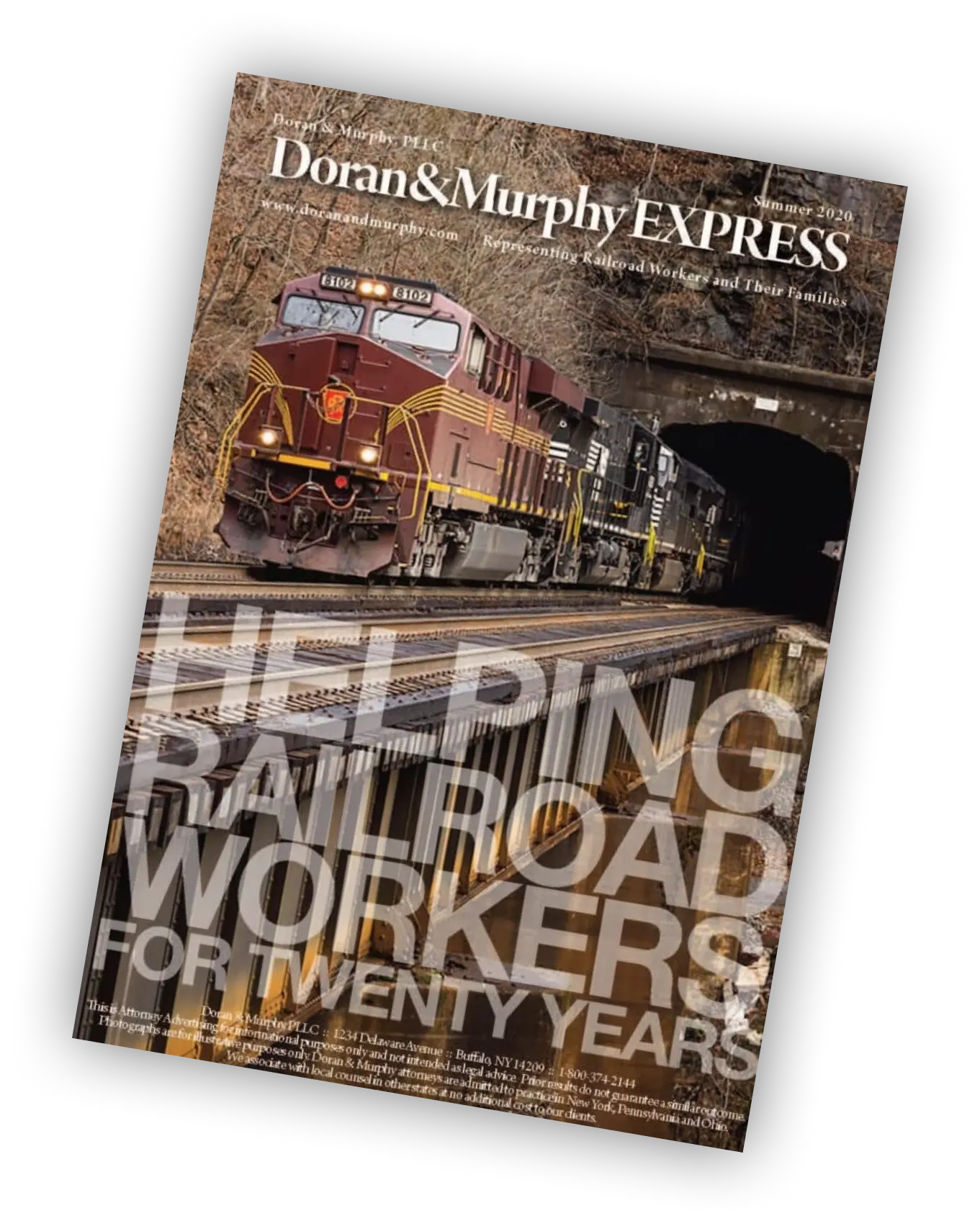
Sign up for Our Newsletter Doran & Murphy EXPRESS



© 2026
Doran & Murphy, PLLC
All rights reserved | Attorney Advertising